
Main sewer line · Mostly a job for a pro · Updated November 2026
How to unclog a sewer line.
The honest guide from a professional plumber. How to tell it is the main line, the few things you can safely do yourself, and what it takes to clear it.
 By Andrew HendersonRed Seal Plumber
Sewage coming up right now?
1. Stop using water. No flushing, taps, laundry or dishwasher.
2. Keep clear of it. Sewage is a health hazard. Kids and pets out.
3. Find your cleanout. It is where a plumber will start.
Start here
Is it the main line?
A clog in one fixture stays in that fixture. A clog in the main line shows up all over the house, usually at the lowest drain first. These signs point to the main sewer line:
- Water comes up in the tub, shower or floor drain when you flush or run the washer
- More than one toilet or drain is slow at the same time
- The lowest drain in the house backs up first
- Drains gurgle when water runs somewhere else
- You can smell sewage, or see it
- The clog keeps coming back within days or weeks
Just one drain
Probably not the main line.
If one toilet, sink or tub is slow and everything else drains fine, the clog is in that fixture. That is a smaller, cheaper job, and often one you can do yourself.
The whole house
That is the main line.
Stop using water and keep reading. A plunger and a hand auger only reach the fixture they are in. Neither one reaches a main line clog.
Know your pipe
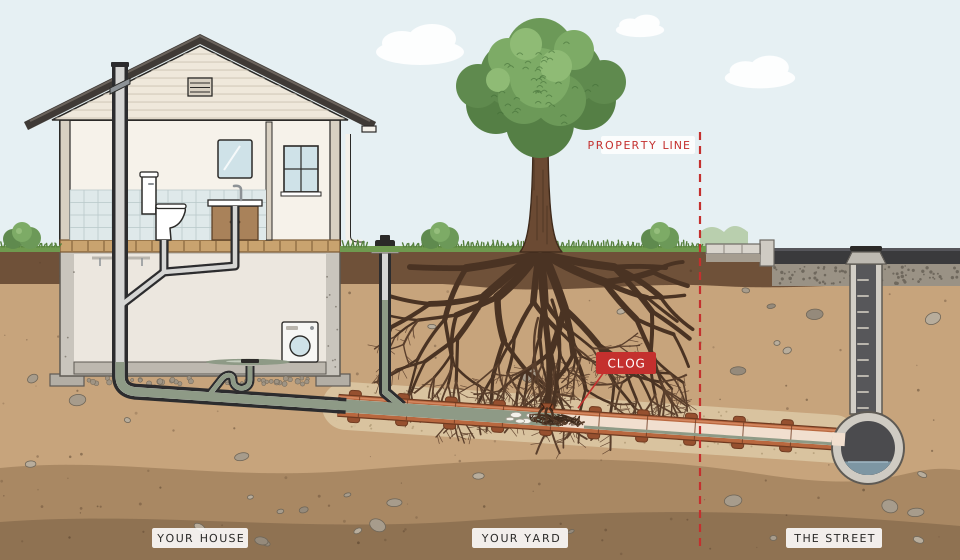
How your sewer line runs.
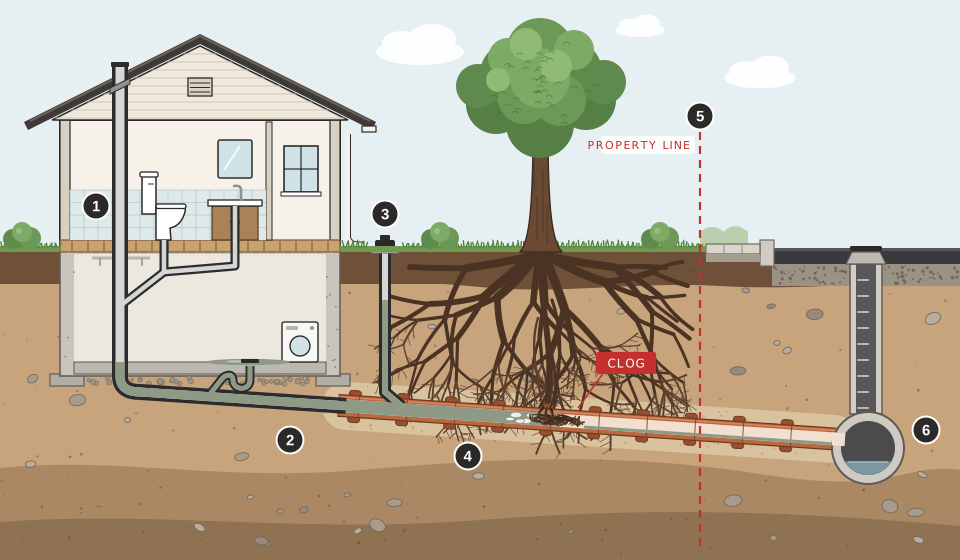
- Fixtures and stack. Every toilet, sink and tub drains into a vertical pipe called the stack.
- Building drain. The pipe under your lowest floor. It collects everything and carries it out through the foundation.
- Cleanout. A capped opening into the line, usually in the basement floor, a crawl space or just outside the foundation. It is how a plumber gets a cable, a camera or a jetter in.
- Building sewer. The buried run across your yard. Most main line clogs are here.
- Property line. You own the pipe up to here, and the municipality usually owns the rest. Rules vary, so check with your city.
- City sewer main. The large pipe under the street. If it is blocked, your neighbours will have the same problem you do.
Steps 1 to 4
What you can safely do yourself.
Not much, and that is the honest answer. A main line needs a machine. These four steps limit the damage and save time once a plumber arrives.
-
Step 1
Stop using water
No flushing, no taps, no laundry, no dishwasher. Whatever goes down a drain comes back up at the lowest one.
Andrew's pro tip: Tell everyone in the house. One shower upstairs can put sewage on the basement floor.
-
Step 2
Find your cleanout
Look for a capped pipe, 3 or 4 inches across, in the basement floor, the crawl space or outside near the foundation. Clear a path to it. Leave the cap on while the line is backed up, because whatever is behind it comes out.
Andrew's pro tip: Knowing where the cleanout is before we arrive is the biggest time saver there is.
-
Step 3
Ask the neighbours
If the houses beside you are backing up too, the blockage is likely in the city main. Call your municipality before you call a plumber.
-
Step 4
Note what you see
Which drains backed up, when it started and whether it has happened before. Take a photo. It tells the plumber where to start.
Leave these alone.
- Chemical drain cleaner. It will not clear a main line, and it sits in the pipe where someone has to work.
- A plunger or a hand auger. Neither one reaches past the fixture.
- A rented drain machine, unless you have run one before. A cable under load can kink, whip and injure.
- A garden hose down the cleanout. It adds water to a line that is already full.
Open the printable checklistSewage in the basement right now?
Why it happens
What blocks a sewer line.
Cause 1
Tree roots
Roots find the joints in older clay and concrete pipe and grow into a mat that catches everything behind it. More on roots.
Cause 2
Grease and buildup
Cooking fat cools and hardens on the pipe wall, and the opening gets narrower year by year.
Cause 3
Wipes and objects
Wipes, period products and paper towel do not break down the way toilet paper does. They snag at rough joints and pile up.
Cause 4
A sag in the pipe
The ground settles and leaves a low spot, called a belly, where water sits and solids drop out.
Cause 5
Broken or shifted pipe
Cracked, collapsed or offset pipe stops paper at the break. Cleaning buys time, but it does not fix the pipe.
Cause 6
The city's side
Sometimes the blockage is past your property line. Your pipe or the city's.
What a plumber does
How a sewer line gets cleared.
- Finds the way in. Through the cleanout. If the house has none, a toilet is lifted for access and reset on a new seal, priced before it is lifted.
- Checks the water level. How full the line is shows roughly how far away the blockage is.
- Runs the drain machine. A large drum machine drives a cable with a cutting head through the blockage.
- Reads the cutting head. Roots, wipes or grease on the head show what was in the pipe.
- Proves it drains. Water is run from several fixtures to show the line carries full flow.
- Tells you what was found. What blocked it, how likely it is to come back, and whether it was on your side of the property line.
The three tools
First tool
Drain machine
A powered cable with a cutting head goes in through the cleanout and bores through the blockage. It clears most main line clogs.
From $769
What the price includesSee the cause
Camera inspection
A camera on a cable shows what the blockage was and where: roots, a sag or a break. Add it to a clearing visit for $249.
Typically $489 to $719+
What a camera inspection showsDeep clean
Hydro jetting
High-pressure water scours the whole pipe wall. It is the answer for grease, sludge and heavy buildup. It needs a jetting truck.
Typically $1,089 to $2,989+
Jetting or a drain machine
Prices are Unclog.it's, for regular hours: 9 to 5, Monday to Friday. After hours, prices double. Typical pricing is a guide, and the price for your job is confirmed before work starts.
Step 5 · Call it in
Backed up? Unclog.it.
A main line needs a drain machine and a licensed plumber to run it. We clear the line through your cleanout and show you it drains before we leave.
A plumber clears a main sewer line from $769 in regular hours (9 to 5, Monday to Friday). After hours, prices double.
Metro Vancouver and the Fraser Valley, British Columbia
When cleaning stops working
Clean it, repair it or replace it.
Most sewer lines are cleared and stay clear. If yours backs up again, a camera inspection shows why. These are the signs it has become a repair:
- The same clog returns every few months
- The camera shows cracked, collapsed or shifted pipe
- A sag still holds water after the line is cleaned
- Roots are back soon after they were cut out
Sewer line repair
Digging up and replacing the damaged section.
Typically $5,489 to $19,989+
Sewer line replacement
A new line from the house to the property line.
Typically $15,989 to $29,989+
Larger projects start with a paid on-site estimate, credited toward the approved estimate.
Questions.
Short answers from a plumber. Tap a question to open it.
Can I unclog a main sewer line myself?
Rarely. The clog is usually far down a 3 or 4 inch pipe, and it takes a powered drain machine to reach it and cut through it. What you can do is stop using water, find the cleanout and check whether the neighbours have the same problem.
Is the clog on my side or the city's?
If the neighbours are backing up too, it is probably the city main, and your municipality is the first call. If it is only your house, it is most likely on your side. Your pipe or the city's.
Where is my sewer cleanout?
Look for a capped pipe, 3 or 4 inches across, in the basement floor near the wall that faces the street, in the crawl space, or outside near the foundation. Some homes have none. Where to look.
Will drain cleaner clear a sewer line?
No. It will not reach the blockage at any strength, and it does nothing to roots or a broken pipe. If you have already poured some in, tell the plumber before they start.
How long does it take to clear?
Most main lines are cleared in a single visit. Unclog.it's price covers up to 2 hours on site.
Does home insurance cover a sewer backup?
Only if your policy includes sewer backup cover, which is often an optional extra. Check your policy, and take photos before any cleanup.
How do I stop it happening again?
Flush toilet paper and nothing else, and keep grease out of every drain. If roots were found, have the line cleaned every year or two. Tree roots in a sewer line.
More sewer line help
One question, one page.
Meet the author
Andrew Henderson, Red Seal Plumber
Andrew has been clearing drains in Metro Vancouver and the Fraser Valley for more than 15 years. He founded Pure Mechanical Group, the company behind Unclog.it, and contributed to the Red Seal Occupational Standard, the national standard plumbing apprentices train to.
Legal disclaimer
The information on this site is provided for general educational purposes only and does not constitute professional advice. Plumbing work can cause property damage or personal injury if performed incorrectly. Proceed at your own risk. Always follow local codes and manufacturer instructions. If you are unsure at any time, stop and contact a licensed professional plumber.
Unclog.it and Pure Mechanical Group Ltd. make no warranties or guarantees and expressly disclaim liability for any loss, damage, or injury arising from the use of this content. By using this site you agree to these terms.